Percentage Calculator with Step-by-Step Solutions
Work out a percent of any number, find what percent one value is of another and calculate percentage increase or decrease, with the method shown.
More math tools
√xAI Math SolverSolve any math problem with clear stepsx²Equation SolverLinear, quadratic and systems of equations∫Integral CalculatorDefinite and indefinite integralsd/dxDerivative CalculatorDerivatives with every rule explained[⋮]Matrix CalculatorDeterminant, inverse and multiplicationσStatistics CalculatorMean, median, mode and standard deviation
How to use the percentage calculator
- Type the question in plain form. Use one of three patterns:
15% of 240,45 is what percent of 180orpercent change from 80 to 100. - Press Solve Now. The calculator recognises the type of percentage problem and applies the matching formula.
- Check the working. The steps show the conversion and the arithmetic, and the final box gives the answer, including whether a change is an increase or a decrease.
Free Percentage Calculator for Everyday and School Problems
Percentages are everywhere: discounts in shops, tips in restaurants, interest on savings, tax on a salary, battery levels on a phone, test marks, survey results and news headlines about prices going up or down. The word percent simply means per hundred, so 25% means 25 out of every 100, or the fraction 25/100 = 1/4. Once you see a percentage as a fraction of 100, every percentage problem becomes a short multiplication or division.
This percentage calculator handles the three questions people ask most often and shows the method each time, so you can repeat it in your head or on paper. It works with whole numbers, decimals and negative values, and it tells you clearly whether a change is an increase or a decrease.
The three core percentage questions
Almost every percentage problem is one of these three types. Recognising which one you have is the hardest part, and the calculator does that for you.
- What is P% of a number? Example: what is 15% of 240? Convert 15% to the decimal 0.15 and multiply: 0.15 × 240 = 36.
- What percent is A of B? Example: 45 is what percent of 180? Divide the part by the whole and multiply by 100: 45 / 180 × 100 = 25%.
- What is the percentage change from A to B? Example: from 80 to 100. Subtract the old value from the new one, divide by the old value and multiply by 100: (100 − 80) / 80 × 100 = 25% increase.
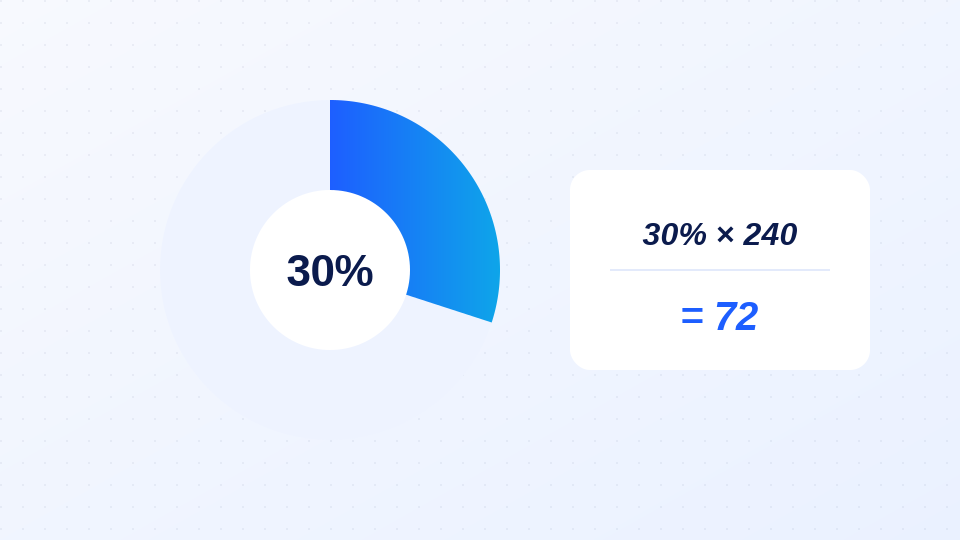
Finding a percentage of a number
To find P% of a number N, multiply N by P/100. Moving the decimal point two places to the left turns a percentage into a decimal: 15% becomes 0.15, 7.5% becomes 0.075 and 120% becomes 1.2. Then multiply.
There are also useful mental shortcuts. 10% of a number is the number divided by 10, so 10% of 240 is 24. 5% is half of that, 12. Adding them gives 15% = 36. 1% is the number divided by 100, and 50% is half. With these building blocks you can estimate most percentages quickly and then use the calculator to confirm the exact value.
A neat trick is that x% of y always equals y% of x. So 8% of 50 is the same as 50% of 8, which is obviously 4.
Finding what percent one number is of another
To find what percent A is of B, divide A by B to get a fraction of the whole, then multiply by 100 to turn it into a percentage. If you answered 42 questions correctly out of 60, your score is 42 / 60 × 100 = 70%. If a recipe uses 150 g of sugar in a 600 g cake, sugar is 25% of the cake. The calculator shows the fraction and the multiplication, and gives the result rounded sensibly when it is not a whole number.
Percentage increase and decrease
Percentage change compares a new value with an original value. The formula is: percentage change = (new − old) / old × 100. A positive result is an increase and a negative result is a decrease.
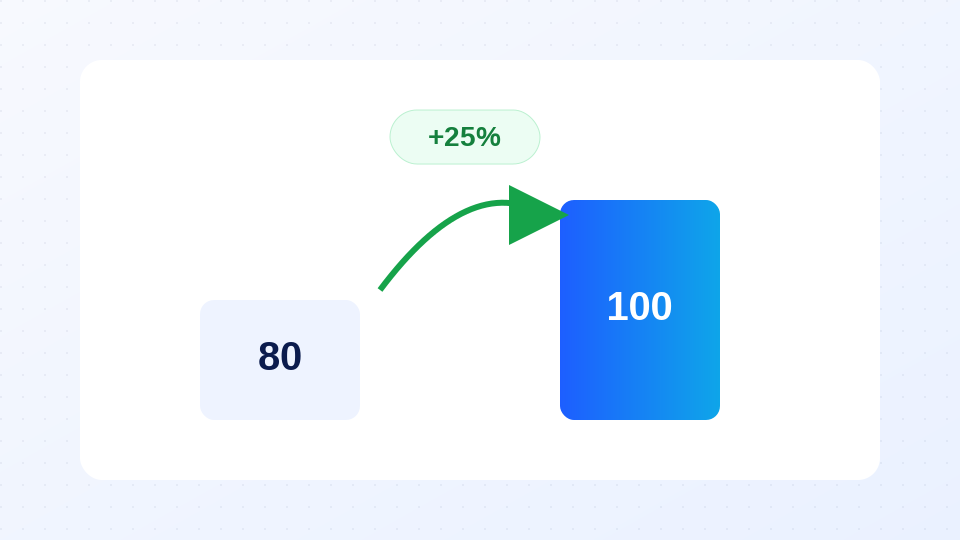
For example, if a monthly bill rises from 80 to 100, the change is 20, and 20 / 80 = 0.25, so the bill has gone up by 25%. If a price falls from 50 to 40, the change is −10, and −10 / 50 = −0.2, which is a 20% decrease. To use the calculator, type percent change from 80 to 100 or from 50 to 40.
The key point is to always divide by the original value, not the new one. That is why a 25% increase followed by a 25% decrease does not return you to where you started: 80 becomes 100, but 25% off 100 is 75, not 80.
Percentage points versus percent
News reports often mix these up. If an interest rate rises from 4% to 5%, it has risen by one percentage point, but by 25% in relative terms, because 1 is 25% of 4. Percentage points describe the simple difference between two percentages, while percent change describes the relative change. Both are correct when used properly, but they measure different things.
Discounts, tax and tips
Many everyday calculations combine a percentage with addition or subtraction.
- Discount: a 30% discount on a price of 60 is 0.30 × 60 = 18, so the sale price is 60 − 18 = 42. A faster way is to multiply by 0.70 directly, because you pay 70% of the original.
- Sales tax or VAT: adding 20% tax to 45 gives 45 × 1.20 = 54.
- Tip: a 15% tip on a bill of 38 is 0.15 × 38 = 5.70.
- Successive changes: a 10% increase followed by another 10% increase multiplies by 1.10 twice, which is 1.21, a total increase of 21%, not 20%.
For each of these, you can use the calculator to find the percentage amount with 30% of 60, then add or subtract it yourself.
Reverse percentages
Sometimes you know the value after a change and want the original. If a jacket costs 84 after a 30% discount, the price you paid is 70% of the original, so the original was 84 / 0.70 = 120. A common mistake is to add 30% of 84 back on, which gives 109.20 and is wrong, because the 30% was taken from the original price, not from 84. Reverse percentage questions can be written as an equation, 0.7x = 84, and solved with the Equation Solver, which shows each step.
Converting between percentages, fractions and decimals
- Percent to decimal: divide by 100. 35% = 0.35.
- Decimal to percent: multiply by 100. 0.08 = 8%.
- Percent to fraction: write over 100 and simplify. 35% = 35/100 = 7/20.
- Fraction to percent: divide and multiply by 100. 3/8 = 0.375 = 37.5%.
Common equivalents worth memorising are 1/2 = 50%, 1/4 = 25%, 3/4 = 75%, 1/5 = 20%, 1/3 ≈ 33.3% and 1/8 = 12.5%. The main AI Math Solver can simplify fractions and convert decimals for you.
Compound growth and interest
When a percentage change repeats over several periods, each change applies to the new value, not the original. This is compound growth. If savings of 1,000 earn 5% interest per year and the interest is added each year, the balance after one year is 1,000 × 1.05 = 1,050, after two years 1,050 × 1.05 = 1,102.50, and after n years 1,000 × 1.05ⁿ. After ten years the balance is about 1,628.89, so the total growth is about 62.9%, noticeably more than ten times 5%.
The same idea works in reverse for depreciation. A car that loses 15% of its value each year keeps 85% of its value annually, so after three years it is worth 0.85³ ≈ 0.614 of the original price, a total fall of about 38.6%. To find the overall percentage change over several periods, multiply the growth factors together, subtract 1 and multiply by 100.
Worked examples
Test score. A student answers 34 out of 40 questions correctly. 34 / 40 = 0.85, so the score is 85%.
Sale price. A pair of shoes priced at 75 is reduced by 20%. The discount is 0.20 × 75 = 15, so the sale price is 60.
Population growth. A town grows from 12,500 to 13,750 residents. The change is 1,250, and 1,250 / 12,500 = 0.10, a 10% increase.
Fuel price drop. Fuel falls from 1.60 to 1.44 per litre. The change is −0.16, and −0.16 / 1.60 = −0.10, a 10% decrease.
Survey share. In a survey of 250 people, 85 chose option A. 85 / 250 × 100 = 34%.
Salary rise. A salary of 2,400 per month increases by 3.5%. The rise is 0.035 × 2,400 = 84, giving a new salary of 2,484.
Percentages in grades and exams
Schools often convert raw marks to percentages so that tests of different lengths can be compared. A mark of 18 out of 25 is 72%, and a mark of 36 out of 50 is also 72%, even though the raw numbers look different. When different parts of a course carry different weights, each part's percentage is multiplied by its weight and the results are added. If an exam worth 60% of the grade is scored at 80% and coursework worth 40% is scored at 90%, the final grade is 0.6 × 80 + 0.4 × 90 = 84%. For longer lists of scores, the Statistics Calculator gives the mean, median and spread.
Estimating percentages quickly
Being able to estimate a percentage in your head is a valuable skill for shopping and for checking calculator results. Round the numbers to friendly values first. To estimate 18% of 395, think of 20% of 400, which is 80, so the answer is a little less, around 71. The exact value is 71.10. To estimate what percent 29 is of 61, notice that 30 is about half of 60, so the answer is roughly 48%. The exact value is about 47.5%. Estimation catches typing errors immediately: if the calculator showed 710 or 7.1, you would know something was wrong.
How to enter percentage problems
- Use the % sign:
15% of 240, or the word:15 percent of 240. - For what percent, write
45 is what percent of 180. - For change, write
percent change from 80 to 100or simplyfrom 80 to 100. - Use a dot for decimals:
7.5% of 320. - Negative values are allowed for changes, for example a temperature change from −5 to 10.
Common percentage mistakes
- Dividing by the new value instead of the original when finding percentage change.
- Adding percentages of different bases, such as assuming two 10% rises equal 20%.
- Reversing a discount by adding the same percentage back, which overshoots.
- Confusing percentage points with percent change.
- Forgetting to convert 15% to 0.15 before multiplying.
Where percentages are used
Percentages make comparisons fair when totals differ. A shop can compare sales growth across stores of different sizes, a teacher can compare scores from tests with different numbers of questions, and a scientist can report the proportion of a sample with a certain feature. Finance relies on them for interest rates, inflation and returns, and health uses them for body fat, risk and vaccination rates. For more background, see the percentage article on Wikipedia.
Practice problems with answers
Solve these mentally or on paper, then type them into the calculator to check.
- What is 12% of 350. Answer: 42.
- 18 is what percent of 72. Answer: 25%.
- Percent change from 250 to 300. Answer: a 20% increase.
- Percent change from 64 to 48. Answer: a 25% decrease.
- What is 2.5% of 1,200. Answer: 30.
- 9 is what percent of 12. Answer: 75%.
- A price of 40 rises by 15%. Answer: the increase is 6, so the new price is 46.
- After a 25% discount a book costs 18. Answer: the original price was 18 / 0.75 = 24.
Study tips for percentages
Whenever you see a percentage, ask yourself what it is a percentage of. Most errors come from using the wrong base, especially in percentage change and reverse percentage questions. Converting to a multiplier is a powerful habit: an increase of 8% means multiply by 1.08, and a decrease of 8% means multiply by 0.92. Multipliers make repeated changes easy, because you just multiply them together. Finally, estimate before you calculate. A rough answer in your head is the fastest way to notice a misplaced decimal point.
Related tools
Use the Statistics Calculator to summarise a whole list of values, the Equation Solver for reverse percentage and other algebra questions, and the main AI Math Solver for fractions, decimals and mixed arithmetic.
Frequently asked questions
How do I calculate a percentage of a number?
Convert the percentage to a decimal by dividing by 100, then multiply. For 15% of 240, calculate 0.15 × 240 = 36. You can type 15% of 240 into the calculator.
How is percentage change calculated?
Subtract the original value from the new value, divide by the original value and multiply by 100. A positive result is an increase and a negative result is a decrease.
Why does a 20% rise and a 20% fall not cancel out?
The second change is calculated on a different base. 100 rises to 120, and 20% of 120 is 24, so the price falls to 96, not 100.
What is the difference between percent and percentage points?
Percentage points are the simple difference between two percentages, such as 4% to 5% being one point. Percent change is relative, so the same move is a 25% increase.
Can I use decimals in the percentage calculator?
Yes. Decimals such as 7.5% of 320 or 12.75 is what percent of 85 work, as long as you use a dot for the decimal point.
Is the percentage calculator free?
Yes. It is free, requires no account and runs in your browser.